Building on our earlier program-evolution workflow guided by large language models (LLMs), we study weight-five bivariate bicycle (BB) and perturbed bivariate bicycle (PBB) codes. …
Quantum programs can suffer from quantum-specific code smells that cannot be captured by classical unit tests. We propose a framework that analyzes the existing programs released …
Quantum LDPC code discovery requires searching large algebraic design spaces while reliably certifying the parameters and equivalence classes of any candidates found. We present a …
We adapt Microsoft's QuantumKatas - a well-established quantum computing curriculum - from Q# to Qiskit, the most widely-adopted quantum computing framework, and package it with an …
Systems and techniques that facilitate intelligent unitary synthesis for quantum computing are provided. For example, a system can access a unitary matrix of a quantum payload …
A computer-implemented system with machine learning capabilities designed to address quantum computing challenges. The system's recommendation component employs a machine learning …
This paper investigates artificial intelligence (AI) methodologies for the synthesis and transpilation of permutation circuits across generic topologies. Our approach uses …
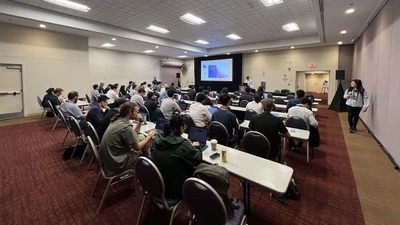
Full-day tutorial at IEEE Quantum Week 2025 (QCE25) on using and training AI-powered transpiler passes in Qiskit for quantum circuit optimization, co-presented with David Kremer …
This paper explores the application of machine learning (ML) techniques in predicting the QPU processing time of quantum jobs. By leveraging ML algorithms, this study introduces …
Qiskit is an open-source quantum computing framework that allows users to design, simulate, and run quantum circuits on real quantum hardware. We explore post-training techniques …
With your consent, this site uses Google Analytics cookies to count visits and see which pages are read.
Nothing is sent to Google unless you accept. Privacy policy