Quantum Error Correction Meets AI for Science: Lessons from LLM-Guided Code Discovery
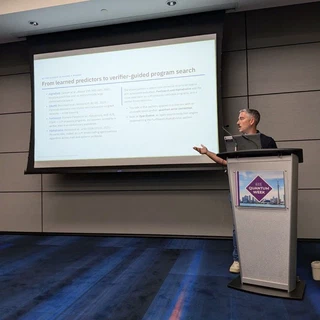 Image credit: AILAB-Udine
Abstract
Invited keynote at the AI for Circuit Synthesis, Optimization, and Discovery (AI4QC) workshop, held alongside IEEE Quantum Week 2026 in Toronto. The talk places LLM-guided program evolution within the broader ‘AI for science’ landscape (AlphaFold, GNoME, FunSearch, AlphaEvolve) and walks through a verifier-guided evolutionary pipeline, built on OpenEvolve, that mutates Python programs generating bivariate-bicycle and perturbed bivariate-bicycle quantum LDPC codes. Screening roughly 2×10^5 candidates across five campaigns surfaced 465 BLISS-distinct codes (97 CSS, 368 non-CSS) at block length n ≤ 360, backed by an independent verification stack — GF(2) rank computation, MILP-based distance bounds, BLISS Tanner-graph deduplication, and local-Clifford equivalence checks — built to expose and correct the search’s own blind spots. The talk closes with transferable lessons on where LLM-guided evolution complements, rather than replaces, reinforcement-learning approaches to quantum error-correcting code discovery.
Date
Sep 17, 2026 3:15 PM — 4:00 PM
Event
Location
Metro Toronto Convention Centre, Toronto, Ontario, Canada
Related paper: Evolutionary Discovery of Bivariate Bicycle Codes with LLM-Guided Search (arXiv:2606.02418).

Authors
Juan Cruz-Benito
(he/him)
Quantum+AI Manager
I research and develop AI-based systems to tackle complex problems in quantum computing and other relevant areas.
My work sits at the intersection of quantum computing, machine learning, and open source. I hold IBM Master Inventor status and have contributed to tools used by millions of developers worldwide.
I have a PhD in Computer Engineering from the University of Salamanca (2018), have authored 80+ publications, and received the 2019 SCIE-BBVA Award for best young researcher in Computer Science in Spain.